
Swiss camera leaves for the Red Planet
Non classé
14 March 2016
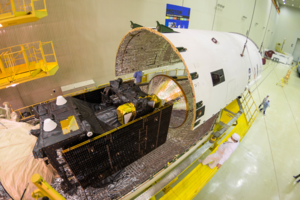
A camera designed and built at the Center of Space and Habitability of the University of Bern was launched into space this morning from the Baikonur Cosmodrome in Kazakhstan. The European Mars satellite ExoMars Trace Gas Orbiter (TGO) is on its way to Mars, where it will search for traces of biological life. Scheduled to […]
A camera designed and built at the Center of Space and Habitability of the University of Bern was launched into space this morning from the Baikonur Cosmodrome in Kazakhstan.
 The European Mars satellite ExoMars Trace Gas Orbiter (TGO) is on its way to Mars, where it will search for traces of biological life. Scheduled to reach its destination in October, it carries CaSSIS (Colour and Stereo Surface Imaging System), a high-resolution stereo camera that will take detailed pictures of Mars’ surface. The development of CaSSIS was led by the University of Bern and completed in cooperation with Swiss industry and partners in Italy, Poland and Hungary. “CaSSIS is the best system we could build with the available resources”, says the leader of the science team, Nicolas Thomas of the Center of Space and Habitability (CSH). It usually takes 38 months to build such a complicated instrument, but the camera was completed in a record time of 23 months.
This launch is the first mission in the ExoMars program, a joint initiative of the European Space Agency (ESA) and the Russian space agency Roscosmos. Its primary scientific objectives are to determine in detail the Martian atmosphere’s composition, in particular the amount of trace gases present, and to acquire high-resolution stereo images of the planet’s surface from orbit. The second mission, which will land an exploration rover, is planned for 2018.