Three questions to Henri Troillet, Director Germany & Nordics
GGBa
3 November 2020
The GGBa is comprised of a network of experienced and passionate investment promotion professionals located around the world. We recently caught up with Berlin-based Henri Troillet, Director Germany and Nordics at GGBa, to talk about the impact of the pandemic on his daily business activities, the current trends in FDI, and the challenges he has addressed […]
The GGBa is comprised of a network of experienced and passionate investment promotion professionals located around the world. We recently caught up with Berlin-based Henri Troillet, Director Germany and Nordics at GGBa, to talk about the impact of the pandemic on his daily business activities, the current trends in FDI, and the challenges he has addressed over the recent months.
How has the Covid-19 pandemic affected your daily life and job?
As with most people, the pandemic has had severe effects on my daily and professional life. My family and I have reduced gatherings with relatives and friends and we have temporarily abstained from many seemingly ordinary things such as eating out, visiting theatres, fitness clubs, museums, etc. Moreover, schools and kindergartens have been closed for several months which meant that my wife and I had to take care of our three kids at home, while at the same time pursuing our professional work. Although I am used to partly working from home, since March this year I have been more or less restricted to only working from home. Meetings with clients and other business partners could rarely take place in person during the last few months, instead, videoconferencing has become the standard way of conducting meetings. Equally, travelling abroad or even within Germany has become difficult and partly obsolete because trade shows and conferences have, to a large extent, also gone virtual.
New restrictions are coming into force across Europe as a second coronavirus wave grips the continent. What is the situation like in your area?
I am responsible for investments from Northern Germany and the Scandinavian countries and live in Berlin. The number of new Covid-infections has recently reached an all-time high in Germany. Therefore, the government has decided to go into a second if lighter lockdown in order to fight the new wave of the pandemic. This entails the interdiction of gatherings of more than 10 people from more than two households in public, and any kind of events. Entertainment and sports facilities are being closed while restaurants can only provide take out services. Travelling within the country is only allowed for imperative professional reasons and in exceptional cases. Hotels are requested to only accept guests accordingly. Most of the Nordic countries are taking similar measures such as curfews and restricting public life and immigration. Sweden is the more liberal exception where the government appeals to the personal responsibility of its citizens to act responsibly. Overall the Scandinavian countries have had slightly more positive infection figures than Germany which is also due to the fact that they are less densely populated.
Many companies around the world have postponed their investment plans – or canceled them altogether – under the influence of the economic crisis driven by the pandemic. What trends have you observed in Germany and the Nordics?
Companies across most industries are challenged by the current situation. When the pandemic cooled off during the summer months, there was some slight hope that the recovery from the first wave would be ongoing, but now we are going through a second downturn and the overall insecurities remain. The effects of the crisis have been disparate for different industries. While many of the classical manufacturing companies such as automotive and heavy industries suffer, other areas have been influenced in a positive way. Typical winners of the crisis can be found for example in the digital and healthcare sectors. Many companies in these fields are addressing the problems posed by the pandemic and are thus strongly growing. These are consequently the areas where I see most investment activity in my region at the moment. Specific trends are for example the growing success of business models concerned with industry automation, remote work or education, medical diagnostics or treatments and telehealth solutions. Other important trends such as new mobility and cleantech products and services are ongoing and also less affected by the crisis. Most companies from these industries are overall well positioned to further expand internationally.
#StaySafeWithGGBa
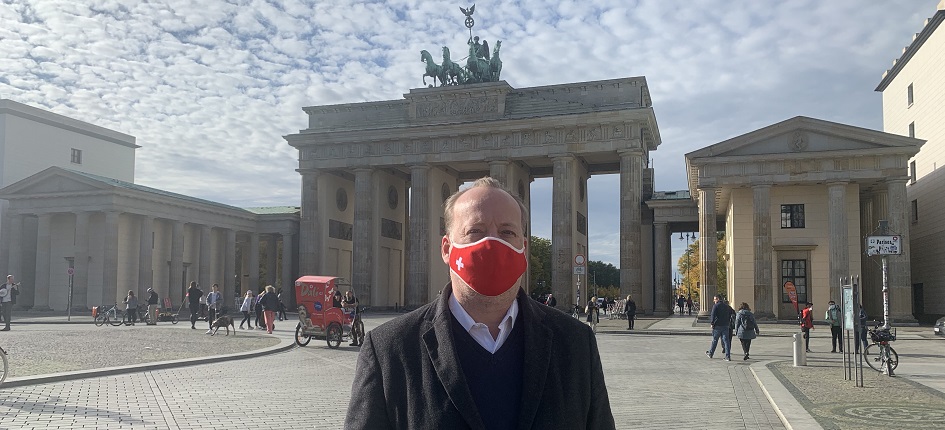
Henri is wearing a Swiss‑made, antibacterial, reusable face mask, 3D‑knitted by
Swiss company Steiger. Since inventing the world’s first fully electronic knitting
machine in 1979, Steiger has been providing the fashion, medical and industrial
sectors with pioneering textile solutions. The latest addition to the company’s
product range is a machine that knits products in three dimensions. Harnessing
innovation and digitalization, Steiger has become a technology leader in a long-
established industry. Today, it knits orthopedic and medical applications, as well
as high‑performance materials such as fiberglass and carbon fiber. The company
has been selected to knit parts for the Solarstratos solar airplane, which will fly at
an altitude of more than 25,000 meters.
The latest information on the coronavirus situation in Switzerland is available here.