
Wireless probes identify cancer cells during surgery
Non classé
13 June 2016
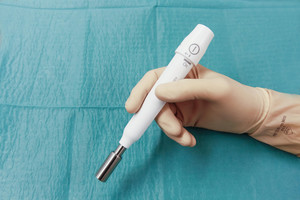
Two compact, light and portable probes that detect traces of cancerous tissue and suspicious lymph nodes during surgery have been developed by EPFL, CHUV and Swiss medtech company Forimtech. Fruit of a partnership between the Swiss Federal Institute of Technology Lausanne (EPFL), the University Hospital of Lausanne (CHUV) and Swiss medtech company Forimtech, the Gamma and […]
Two compact, light and portable probes that detect traces of cancerous tissue and suspicious lymph nodes during surgery have been developed by EPFL, CHUV and Swiss medtech company Forimtech.
 Fruit of a partnership between the Swiss Federal Institute of Technology Lausanne (EPFL), the University Hospital of Lausanne (CHUV) and Swiss medtech company Forimtech, the Gamma and Beta probes were developed to help surgeons identify cancer cells and suspicious lymph nodes as they remove malignant tumors.
Both probes were designed by EPFL researchers. The Gamma probe builds on technology that is already in use in radioguided surgery by finding the sentinel lymph node, i.e., the first lymph node that cancer cells reach prior to spreading to the rest of the body. If it is free of cancer cells, it means the tumor hasn’t spread. The Beta probe is based on a new concept of particle detection: it pinpoints unhealthy cells by searching for positrons, which are given off by tracers injected into the patient that attach themselves to cancer cells. This enables surgeons to preserve as much healthy tissue as possible and helps prevent the disease from spreading further.
The probes were given the CE mark in March 2015 and have already been used in around 30 operations at the CHUV. Testing will now be rolled out to hospitals across Europe, according to an EPFL press release.