A revolution in medical sterilization
Non classé
19 October 2015
Sterilux, a start-up founded by EPFL students, has developed an affordable, environmentally friendly and safe sterilization technology for hospitals in developing countries. While the practice of sterilizing medical equipment before usage is an everyday routine in hospitals in industrialized countries, it is often impossible in emerging countries since steam sterilizers are expensive and require access […]
 Sterilux, a start-up founded by EPFL students, has developed an affordable, environmentally friendly and safe sterilization technology for hospitals in developing countries.
While the practice of sterilizing medical equipment before usage is an everyday routine in hospitals in industrialized countries, it is often impossible in emerging countries since steam sterilizers are expensive and require access to good quality water and a stable electrical energy supply. As a result, the risk of potentially fatal infections is 2 to 20 times higher than in developed countries.
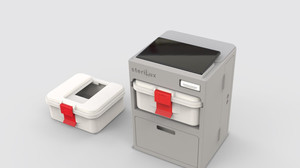
Sterilux, a company founded by EPFL students, has developed a prototype sterilization kit for medical tools that uses 1,000 times less water and 100 times less electricity than conventional equipment used in hospitals, and costs up to 100 times less. The SteriBox, a portable container that can both sterilize and store medical equipment, is placed in a machine that generates ultraviolet light. UV light turns the air’s oxygen into ozone, which in turn sterilizes the medical equipment. The process simulates the oxygen-ozone cycle in the earth’s stratosphere, where ozone is used as means of converting UV radiation into heat.
Designed by Jordane Vernet, a graduate of École cantonale d’art de Lausanne (ECAL), the SteriBox was awarded the James Dyson Award in 2015 for its intelligent and very efficient design.